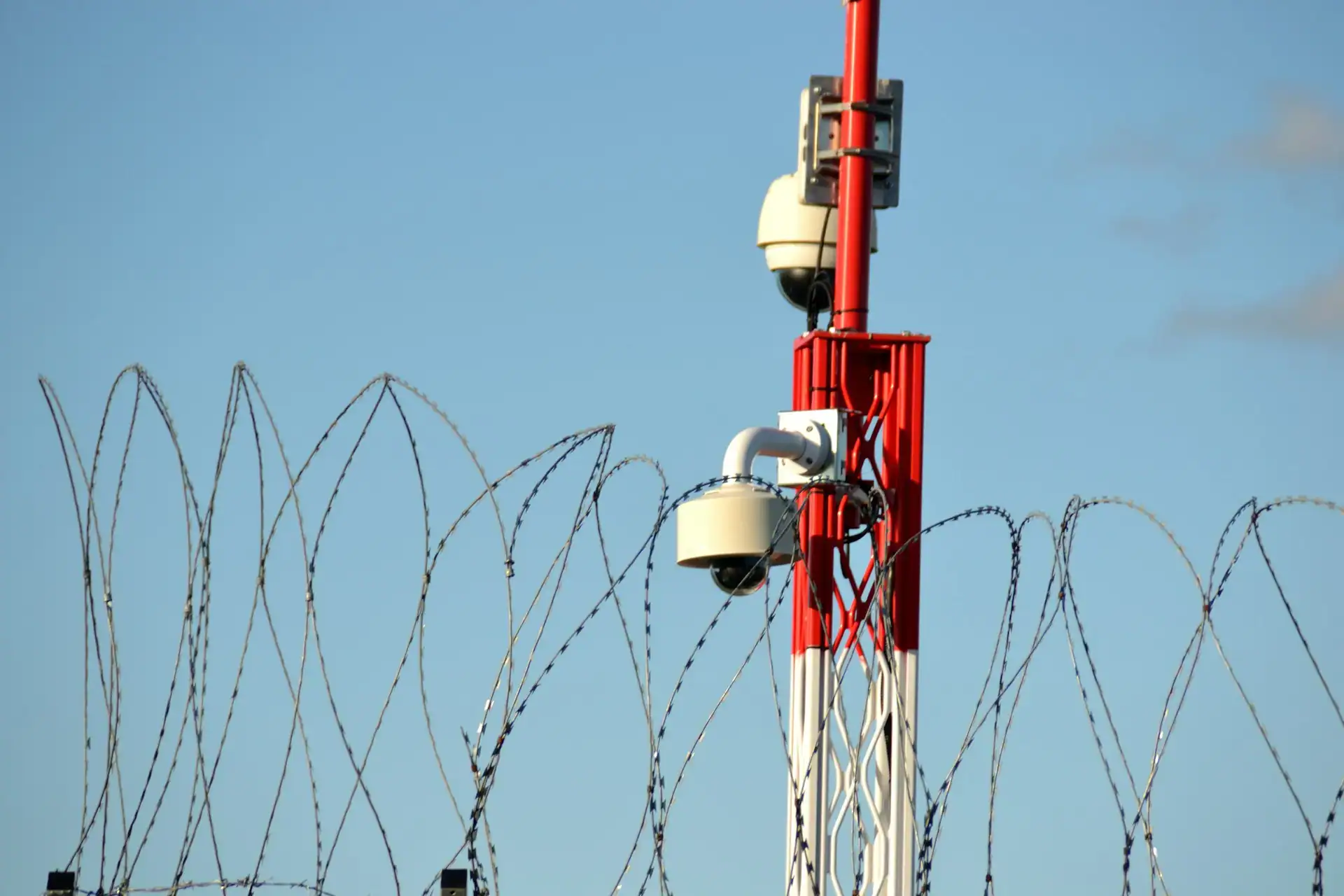
Eine rot-weiß gestreifte Säule mit zwei weißen Dome-Sicherheitskameras hinter einer Barriere aus spiralförmigem S-Draht (Natodraht) vor blauem Himmel

What Is Perimeter Security? Why Modern Security Starts Long Before the Building

14.07.2026 | 6 min read

Many organisations still associate perimeter security with fences, walls or gates. Today, that picture falls short. A fence on its own neither stops a determined intruder nor detects unusual activity or sabotage in time.

Modern perimeter security takes a different approach. Its purpose is to detect threats early, assess them and enable a proportionate response — before an attacker reaches buildings, technical installations or particularly sensitive areas.

That is where its real value lies. Perimeter security is not a single measure but the first physical layer of protection within an overall physical security concept. Only the interplay of structural, technical and organisational measures creates the basis for effective physical security.

Perimeter Security: Definition and Scope

Perimeter security refers to protecting the outer boundaries of a site, facility or building against unauthorised entry, break-ins, sabotage and other physical threats.

The term covers considerably more than a property boundary. Perimeter security includes both physical barriers and systems for detection, monitoring, assessment and alerting.

The goal is to identify security-relevant events as early as possible, leaving enough time to take appropriate countermeasures.

Depending on the level of protection required, a perimeter security concept may include:

  • structural barriers such as fences, walls, gates or bollards,
  • sensors that detect climbing or cutting attempts,
  • video surveillance with intelligent video analytics,
  • radar, LiDAR or thermal sensor technology,
  • lighting that supports detection,
  • and connection to a security control room or a higher-level security management system.

What matters is not the individual technology, but how the components work together within a risk-based security architecture.

Why Early Threat Detection Matters

Physical attacks rarely begin at the building door. In many cases, a person first approaches the site, observes routines, or attempts to enter the outer area unnoticed.

The earlier such activity is detected, the more options remain for a response. Effective perimeter security can, for example, help to

  • identify unauthorised access attempts at an early stage,
  • alert security personnel in good time,
  • reduce false alarms through intelligent assessment,
  • better protect physical assets and critical infrastructure,
  • avoid business interruptions,
  • and initiate security measures in a targeted way.

For data centers, industrial plants, energy suppliers, logistics sites and other security-critical facilities in particular, perimeter security often forms a fundamental part of the overall security concept.

Perimeter Security in a Multi-Layered Security Concept

Modern physical security typically follows a multi-layered approach.

Rather than relying on a single measure, several layers of protection are combined. If one layer fails or is overcome, further security measures remain in place.

Perimeter security forms the outermost physical layer.

Subsequent layers may include:

  • defined entry points and access routes,
  • access control systems,
  • video surveillance within the site,
  • building security,
  • security control rooms,
  • and organisational measures and emergency procedures.

Which measures are required always depends on the level of protection needed, the threats involved and the operational requirements.

Which Technologies Are Used in Perimeter Security?

A modern perimeter security system combines different technologies with different roles. While some systems detect intrusion attempts, others support verification or the operational response.

Physical Barriers

Fences, walls, gates, barriers and bollards form the physical foundation of perimeter security.

They are intended to make unauthorised entry more difficult, restrict access to defined areas and slow intruders down as much as possible. On their own, however, physical barriers do not prevent every threat and do not detect security-relevant events.

Fence Sensors

Fence sensors monitor mechanical changes to a fence line.

Depending on the system, they can detect climbing attempts, cutting or strong vibration and trigger a corresponding alarm. Actual performance depends on the sensor technology, the installation and the environmental conditions, among other factors.

Video Surveillance and Intelligent Video Analytics

Cameras provide the visual basis for assessing events at the perimeter.

Modern video analytics support the automatic detection of security-relevant situations. They can, for example, distinguish people from vehicles or identify unusual movement patterns.

Such systems can reduce the number of unnecessary alarms, but they do not replace human assessment of security-critical events.

Thermal Cameras

Thermal cameras capture heat radiation rather than visible light.

This allows them to detect people or vehicles even in darkness. As with other sensors, however, their performance depends on the specific operating context and can be affected by severe weather conditions.

Radar and LiDAR Systems

Radar and LiDAR technologies are used for wide-area motion detection.

Radar works with electromagnetic waves and is particularly suited to larger surveillance areas.

LiDAR uses laser pulses for high-precision distance measurement, enabling very accurate spatial detection of objects.

Which technology is appropriate depends on the terrain, the range required, weather conditions and the intended detection objectives, among other factors.

Security Lighting

Lighting serves more than orientation.

It supports the work of other sensors, improves image quality for conventional cameras and can act as a deterrent at the same time.

This is where we come in: e-shelter security plans and integrates perimeter security solutions on a vendor-independent basis — from sensors at the fence line and intelligent video analytics through to connection to a certified security control room. If you want to know where your perimeter stands today, our Resilience Health Check is the fastest way in.

How Does Modern Perimeter Security Work?

Whatever technology is deployed, modern perimeter security typically follows a similar sequence.

1. Detection

Sensors or cameras register movement or anomalies along the perimeter.

2. Assessment

The information captured is evaluated. Intelligent analytics can help distinguish security-relevant events from harmless situations.

3. Alerting

If a relevant event is identified, the responsible security function or a higher-level management system is alerted.

4. Response

Depending on the security concept, different measures can then be initiated — for example verification by security personnel, targeted camera tracking, or further organisational response procedures.

What matters here is less the speed of any individual sensor than the coordinated interplay of all the systems involved.

What Role Does Perimeter Security Play in Critical Infrastructure?

Organisations with heightened protection needs place particular demands on perimeter security.

These include operators of data centers, energy facilities, industrial companies and other sites with security-critical processes.

Depending on the regulatory framework, physical security measures may form part of statutory or sector-specific requirements. Which rules apply in an individual case depends on the facility, the level of protection required and the applicable regulations, among other factors.

Regardless of regulatory requirements, however, modern perimeter security always pursues the same objective: to identify risks early and support the resilience of critical processes.

Conclusion

Perimeter security does not begin at the fence, and it does not end at the property line. Its real task is to detect threats as early as possible and integrate them into a coordinated security concept.

That is why the quality of a perimeter security system is determined today not by any single technology, but by the interplay of structural measures, intelligent sensor technology, monitoring, organisational processes and a risk-based security strategy.

Which concept is appropriate always depends on the level of protection required, the operational requirements and the specific threats involved. Modern perimeter security is therefore less a single security measure than the first physical layer of protection within an overall security concept.

e-shelter security plans, integrates and operates perimeter security for data centers, energy suppliers and industrial and logistics sites — vendor-independent and aligned with your security and compliance requirements. Talk to our experts directly, we help you from the initial site assessment through to the finished concept.

— More interesting articles