Contact Form – Event Innovation Forum
Read article

The technological revolution is transforming the architecture and design industry: smart buildings are reshaping how we live and work. According to Mordor Intelligence, the global smart building market is valued at around 163 billion US dollars in 2026 and is projected to grow to 356 billion US dollars by 2031, at a compound annual growth rate of 16.95 percent. Key drivers include rising energy costs, sustainability targets, and the accelerating integration of IoT, AI, and building automation.
But what exactly is a smart building — and what sets a truly intelligent building apart from a conventional one? In this article, we provide a clear smart building definition, present real-world examples, and explain the key technologies behind the concept.
One essential feature of smart buildings is technological innovation. Their infrastructure and systems are equipped with automated processes that optimize energy efficiency, security, usability, and accessibility.
Unlike conventional buildings that operate their systems — heating, lighting, access control, security — in isolation, a smart building connects all these components on a central platform. The systems communicate with each other, respond to user behavior, and optimize themselves in real time. The result: lower energy consumption, stronger security, and a noticeably better user experience.
The technology is applied so that it works for people in private residences, offices, warehouses, and commercial buildings. The different systems all serve one purpose: to give residents and users greater comfort, convenience, and safety.
Smart buildings are a cornerstone of the architecture of the future — and they must meet certain criteria to live up to that name.
A smart building must be sustainable from the basement to the roof. This applies not only to building materials but also to the systems that manage the consumption of resources such as electricity. Systems that control and regulate the use of natural resources like sunlight and water drive greater energy efficiency.
Buildings account for roughly 40% of total energy consumption and 36% of CO2 emissions (according to the International Energy Agency). An energy management system combined with a smart building platform can significantly reduce energy use. Through photovoltaic systems, buildings can cover their own energy needs and feed surplus capacity back into the public grid.
How sustainable a building truly is can be verified through independent certifications — such as BREEAM (Building Research Establishment Environmental Assessment Method) or LEED (Leadership in Energy and Environmental Design).
Every smart building needs a “brain” — a central platform that integrates all systems and ensures that every process runs correctly. This building automation enables the building to take on numerous functions: recognizing people, regulating room temperature, switching off lights in empty offices, or sending elevators to the ground floor when many people are waiting.

Building automation is used to monitor general operations as well as to control energy management, temperature, security alerts, and access control. The benefit: the building becomes smarter, safer, more sustainable, and more comfortable — for users and operators alike.
Technology makes it possible to equip buildings with innovative security systems that protect the people who live or work in them. Seamless access control prevents unauthorized individuals from entering sensitive areas — protecting against theft, vandalism, data misuse, and industrial espionage. Video surveillance, sensors, and hazard detection systems enable rapid detection, response, and evacuation in the event of emergencies or incidents.
Building security is not an isolated function but part of an integrated platform — connected with access control, alarm management, and 24/7 monitoring.
From an architectural perspective, a building must serve a specific purpose — and ideally adapt quickly and easily to future requirements. An intelligent building should always be flexible. The answer lies in modular design, both in terms of IT infrastructure and physical construction, without compromising on aesthetics and the comfort of the spaces.
Would you like to make your building smarter or develop a new site as a smart building? e-shelter security plans, implements, and operates end-to-end smart building solutions — scalable and certified. Learn more about our Building IoT solutions.
Intelligent buildings offer tangible value for both operators and users — well beyond the purely technological.
Energy savings and cost reduction: Automated control of lighting, heating, cooling, and electricity consumption significantly reduces energy costs. Sensors detect which areas are in use — and switch everything else off.
Enhanced security: Integrated access control, video surveillance, and hazard detection systems reliably protect people, equipment, and data. Incidents are detected and reported in real time.
Higher productivity and comfort: Employees benefit from pleasant working conditions — optimal room temperature, automatic lighting, simple room booking via app. This creates a workplace that strengthens well-being and performance in equal measure.
Scalability and future-readiness: Smart buildings can be expanded modularly. New technologies, locations, or usage requirements can be integrated without major renovations.

Imagine walking into the office. You no longer need a keycard or a code — thanks to biometric facial recognition, doors open for you automatically. At your desk, a sensor reminds you to take a break or adopt a more ergonomic posture. When you leave the office and no activity remains, lights and other devices switch off automatically to save energy.
The foundation for this is networked, intelligent building technology. Sensors capture occupancy and environmental data, smart building software analyzes it in real time, and apps allow users to easily book and manage rooms, parking spaces, or resources. Building automation, access control, and energy management work seamlessly together.
This may still sound like science fiction — but the scenario is no longer as utopian as it once seemed. In many cities, intelligent office buildings are becoming a reality step by step. A welcome side effect: employees are more productive, feel better, and enjoy their work more.
The Building Internet of Things (BIoT) connects all internet-capable building elements to improve operational efficiency, reduce energy consumption, enhance interaction between building users, meet sustainability goals, and maximize financial performance.
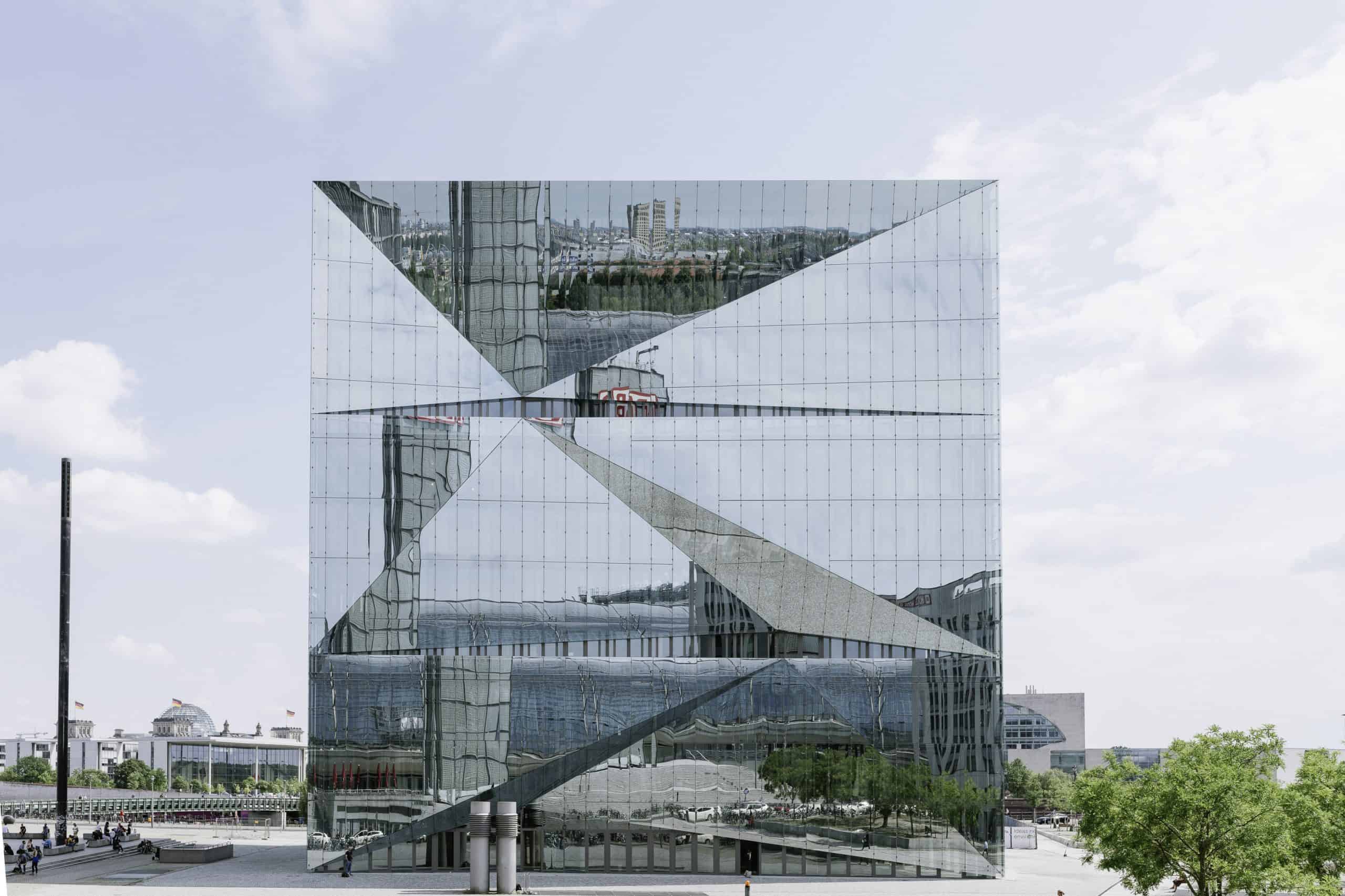
It’s one of our favorite topics at e-shelter security — because it’s a core component of our smart building solutions. We like to illustrate this with the example of cube berlin, the architectural centerpiece of one of Berlin’s most important squares. The building offers its tenants a genuine workplace of the future, defined by sustainability, resilience, and opportunities for knowledge exchange.
e-shelter security and its partner Thing Technologies GmbH contributed to the creation of this project, which has become one of the smartest office buildings in Europe. Thing Technologies GmbH was acquired by MazeMap in February 2026 and now operates as MazeMap GmbH.
Our smart building solutions are built on the system and analytics platform from Thing-it. We integrate various building systems such as intelligent lighting control, building automation, elevator control, and access control. On top of that, we connect IT applications such as Office 365, CAFM, and service management systems to create a holistic system architecture and integrated solutions for smart buildings and offices.
e-shelter security combines physical security with intelligent building technology. As a vendor-agnostic systems integrator, we plan, implement, and operate end-to-end smart building solutions — from access control and video surveillance to IoT-based analytics platforms.
Our solutions are scalable, certified, and designed for the requirements of data centers, industrial sites, corporate headquarters, and critical infrastructure. Whether for new builds or retrofits, we integrate smart building technologies seamlessly into existing building structures and security systems.
Learn more about our Building IoT solutions.
Smart buildings are far more than a technological trend — they are the answer to rising energy costs, growing security demands, and the pressure to be more sustainable. An intelligent building unites sustainability, controllability, security, and flexibility on an integrated platform.
The market is evolving just as dynamically: the global smart building market is projected to grow from 163 billion US dollars in 2026 to 356 billion US dollars by 2031. Companies and building operators that invest in smart building technology now secure a decisive competitive advantage.
Would you like to make your building smarter? Contact us — we’ll advise you without obligation.
You need to load content from reCAPTCHA to submit the form. Please note that doing so will share data with third-party providers.
More InformationYou are currently viewing a placeholder content from Turnstile. To access the actual content, click the button below. Please note that doing so will share data with third-party providers.
More InformationYou are currently viewing a placeholder content from Facebook. To access the actual content, click the button below. Please note that doing so will share data with third-party providers.
More InformationYou are currently viewing a placeholder content from Instagram. To access the actual content, click the button below. Please note that doing so will share data with third-party providers.
More InformationYou are currently viewing a placeholder content from X. To access the actual content, click the button below. Please note that doing so will share data with third-party providers.
More Information