— New Work
How technology can deliver safer and more secure office environments? Through e-shelter’s modular Smart Building solutions, we can enable new, flexible office concepts that help ensure a safer and more secure return to work.
Read article
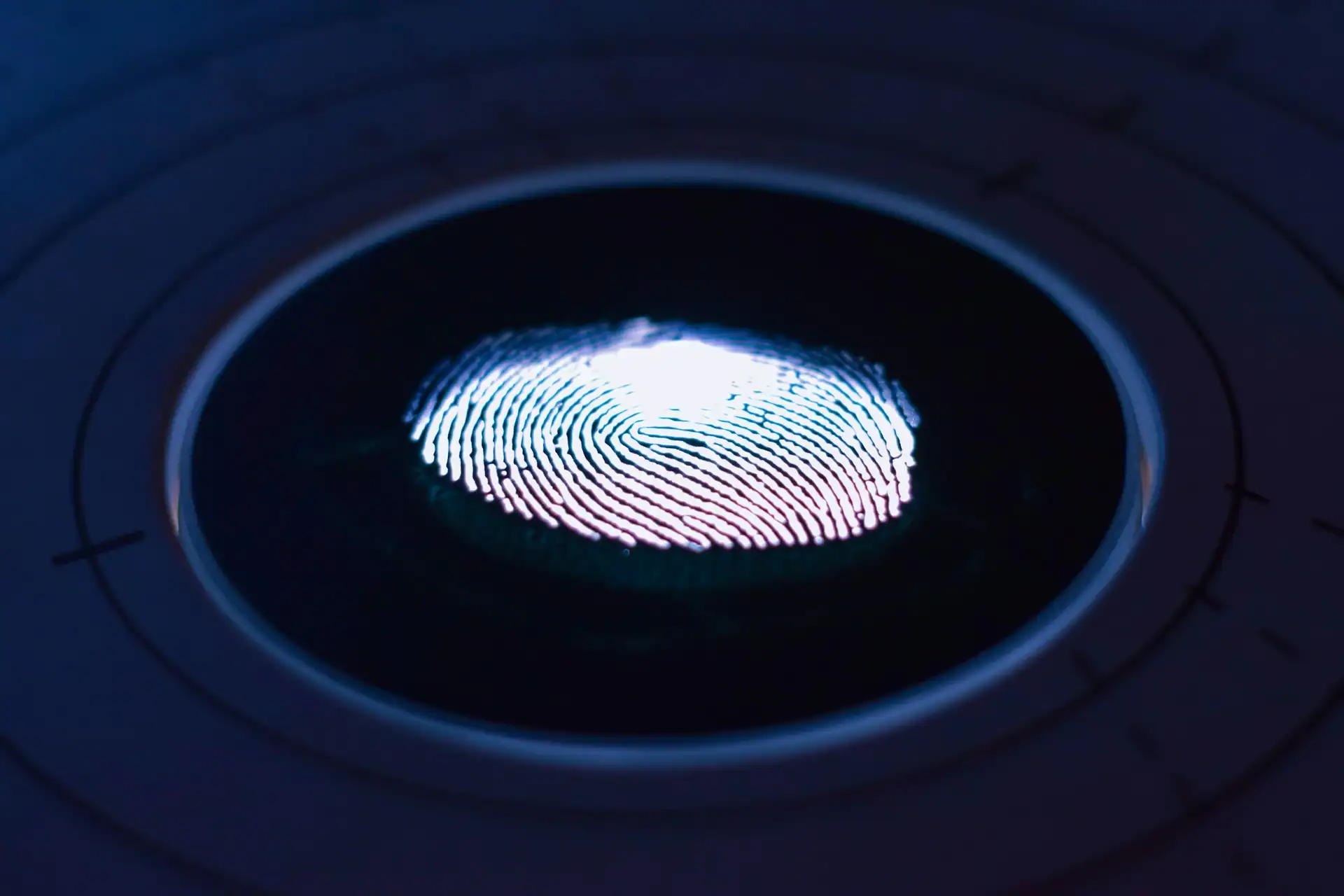
The question of which biometric method is the most secure is asked frequently. Technically, however, that perspective falls short.
In professional access systems, the security level is not determined by the biometric trait alone, but by the interplay of system architecture, attack protection, storage, operation, and regulatory integration.
This article provides a technical overview for evaluating biometric access control. It outlines key criteria for architecture, security, and data protection, but does not replace a project-specific assessment or a concrete system selection.
Biometric access control uses physical traits such as fingerprint, iris, vein pattern, or face to identify a person or to verify a claimed identity.
This is precisely where the central challenge lies: depending on implementation and operating model, the same method can be used both for highly secure and for unsuitable systems.
For practice, this means: not every biometric method fits every protection need. At the same time, the security of biometric access systems cannot be reduced to a simple ranking.
What matters instead is how a method is technically integrated, secured, and operated. Security here encompasses the biometric system performance, the IT security of the architecture, organizational measures, as well as regulatory compliance.
The security of biometric access control results from the interplay of several technical building blocks: the identification model, the system architecture, attack protection, the performance metrics, and the storage and processing of the data.
A fundamental distinction is the one between biometric identification (1:n) and biometric verification (1:1).
In identification, a biometric trait is matched against a large number of reference datasets. This requires a system-wide search and leads to a higher number of comparison operations. From this arise increased demands on system performance, error management, and data protection.
As the reference database grows, the probability also increases that at least one false match occurs within the search process. This scaling effect is particularly relevant for large user groups and influences the practical system design.
In verification, the identity is provided in advance, for example via a card or user ID. The biometric comparison is then performed exclusively against a single reference dataset.
In many classic and controlled biometric access systems with known user groups, verification is therefore frequently used, because it limits the comparison set and makes data processing more controllable.
The choice between identification and verification, however, is not a question of fundamental security, but of the specific application, the system design, and the operational conditions.
In highly sensitive access areas, controlled 1:1 verification processes with additional authentication factors are typically used to limit erroneous decisions and potential for misuse.
In many practical applications, an upstream identification is complemented by a biometric verification. The identification determines the relevant reference dataset, while the biometrics check the match.
This separation can offer advantages:
It does not, however, automatically lead to higher security. The actual protective effect depends substantially on the implementation, the safeguarding of the additional authentication factors, and the operating environment.
Systems without upstream identification are technically possible, but require a correspondingly more comprehensive assessment with regard to performance, error risks, and data protection.
System architecture is therefore an essential factor for the security of biometric access systems, and it stands in close interaction with the quality of the biometric method, the implementation, and the operation.
It is precisely in security-critical environments that biometrics alone do not replace a security concept. What matters is the controlled integration into the overall process.
Biometric systems are fundamentally susceptible to deception attempts, known as presentation attacks. These use artificially created or reproduced traits, such as photographs in facial recognition or replicated fingerprints.
Resistance to such attacks depends substantially on the system design, in particular on methods for the detection of presentation attacks (Presentation Attack Detection, PAD), the sensor technology, and the capture situation.
The evaluation always takes place in the context of a defined threat model and the assumed attacker capabilities, as described, for example, in the ISO/IEC 30107 series of standards.
PAD addresses only attacks at the sensor level. Further attack classes such as replay attacks, manipulation of communication channels, or the theft of biometric reference data must be considered and secured separately.
With Technical Guideline TR-03166, Germany’s Federal Office for Information Security (BSI) provides an evaluation framework for assessing biometric systems with regard to performance and resistance to deception attempts.
Without suitable protective mechanisms, the security of a biometric access system can be limited regardless of the biometric method used.
The performance of biometric systems is typically described via error rates, in particular the False Acceptance Rate (FAR) and the False Rejection Rate (FRR).
These metrics stand in a trade-off: reducing the false acceptance rate usually leads to an increase in the false rejection rate. The actual system performance is substantially determined by the chosen threshold.
The parameterization of a system therefore always takes place in the context of the respective protection need and the operational requirements.
For biometric access control, this means: low error rates are only meaningful in connection with the specific deployment scenario. A system with a very low FAR can nonetheless be unsuitable in practice if the false rejections significantly disrupt operations.
The processing of biometric data involves different data forms, including raw data (samples), extracted features, and reference datasets (templates or models). Depending on the biometric system, these data are stored centrally, in a distributed manner, or on user-bound storage media.
Templates are often described as mathematical representations of extracted features. Their concrete design and their security properties are, however, implementation-dependent. Statements about general non-reconstructability or a uniform security level are therefore not reliable.
At the same time, this does not mean that biometric templates are fundamentally insecure or readily reconstructable. The actual risk depends substantially on the specific system design, the protective mechanisms employed, and the quality of the implementation.
Even when templates are used, the risk of inferences or misuse is not categorically excluded and depends substantially on the protective mechanisms employed. Approaches such as template protection schemes or so-called cancelable biometrics can reduce risks, but are likewise strongly implementation-dependent.
The storage and processing architecture is therefore relevant both for technical security and for the data protection assessment.
Biometric methods differ in their technical properties and deployment conditions.
Fingerprint systems are widely used and economically available, but can be impaired by external influences such as contamination, skin condition, or heavy mechanical strain, and require suitable protective mechanisms.
Iris recognition uses stable patterns of the iris and enables high recognition accuracy, but requires controlled capture conditions and can bring acceptance hurdles in practical use.
Vein systems capture structures located beneath the skin and are less susceptible to surface disturbances, but come with higher technical requirements.
Facial recognition enables contactless processes and high throughput, but is strongly dependent on system design, capture situation, and attack detection. In addition, differences in lighting, perspective, or demographic characteristics can influence system performance.
Combining several biometric methods (multimodal systems) can increase robustness and fault tolerance, but at the same time leads to higher system complexity and additional requirements for the secure fusion of the methods.
A universally valid ranking of biometric methods cannot be derived from this. Depending on protection need and deployment scenario, however, typical strengths and weaknesses of individual methods emerge.
Thus, in high-security environments, methods with a controlled capture situation and additional attack detection are typically preferred, while in environments with high user throughput, contactless methods can offer operational advantages.
This is exactly where we come in: e-shelter security plans and integrates biometric access control systems vendor-agnostically – from a single high-security door to a multi-site solution. If you’d like to know where your access control stands today, our free Resilience Health Check is the fastest entry point.
Under Article 4(14) GDPR, biometric data are personal data obtained through specific technical processing that can enable the unique identification of a person. When they are processed for this purpose, they are subject to the special requirements of Article 9 GDPR.
Image or video data are not automatically biometric data. Only processing for the purpose of automated biometric identification or verification brings them into this regulatory area.
The admissibility of biometric access control depends in particular on the principles of necessity, proportionality, data minimization, and purpose limitation under Article 5 GDPR.
A Data Protection Impact Assessment must be carried out under Article 35 GDPR whenever the processing is likely to result in a high risk to the rights and freedoms of the persons concerned.
In employment contexts, the voluntary nature of consent is regularly limited due to the relationship of dependency. Consent is therefore often not a viable legal basis, especially when no equally suitable, less intrusive alternatives are offered.
At the same time, this does not mean that biometric methods are fundamentally inadmissible in a corporate environment. In high-security areas or critical infrastructure, the use of biometric access control can be justified under suitable technical and organizational conditions.
In these cases, however, the use requires a particularly careful examination of necessity and proportionality.
Biometric access control is not a single security feature, but part of a technical overall system.
The security of a biometric system results from the interplay of:
Which biometric method is suitable therefore depends not on the trait alone, but on the respective deployment context, protection need, and the specific system design.
In professional access scenarios, the question in the foreground is therefore not which method is universally “the most secure.” What matters instead is how a biometric method is integrated into the overall process in a controlled, traceable, and risk-based manner.
e-shelter security plans, integrates, and operates biometric access control for data centers, critical infrastructure, and multi-site organizations – vendor-agnostic and aligned with your security and compliance requirements. Contact us – our experts will guide you from the initial assessment to the fully integrated solution.
You need to load content from reCAPTCHA to submit the form. Please note that doing so will share data with third-party providers.
More InformationYou are currently viewing a placeholder content from Turnstile. To access the actual content, click the button below. Please note that doing so will share data with third-party providers.
More InformationYou are currently viewing a placeholder content from Facebook. To access the actual content, click the button below. Please note that doing so will share data with third-party providers.
More InformationYou are currently viewing a placeholder content from Instagram. To access the actual content, click the button below. Please note that doing so will share data with third-party providers.
More InformationYou are currently viewing a placeholder content from X. To access the actual content, click the button below. Please note that doing so will share data with third-party providers.
More Information